

Sometimes the most upsetting part of a situation is not what actually happened. It is what we decided it meant.
Someone does not return a text message, and we assume they are angry with us. A coworker seems distracted, so we decide they do not respect us. When a friend cancels plans, we may start wondering whether the friendship matters to them at all. Even simple feedback can become criticism, rejection, or judgment once our minds begin interpreting it.
Within a few minutes, a fairly ordinary event can become an entire story in our heads.
The problem begins when we react emotionally to that story as though it were a fact.
For people in recovery, recognizing this pattern can become an important part of emotional sobriety. Learning to regulate our emotions does not mean ignoring our instincts or pretending everything is fine. Instead, it means developing enough distance between an event and our reaction to ask a simple but powerful question:
What do I actually know, and what am I assuming?
That question can prevent a misunderstanding from becoming a resentment, an argument, or something much more destructive.
Our Minds Are Always Trying to Fill in the Blanks
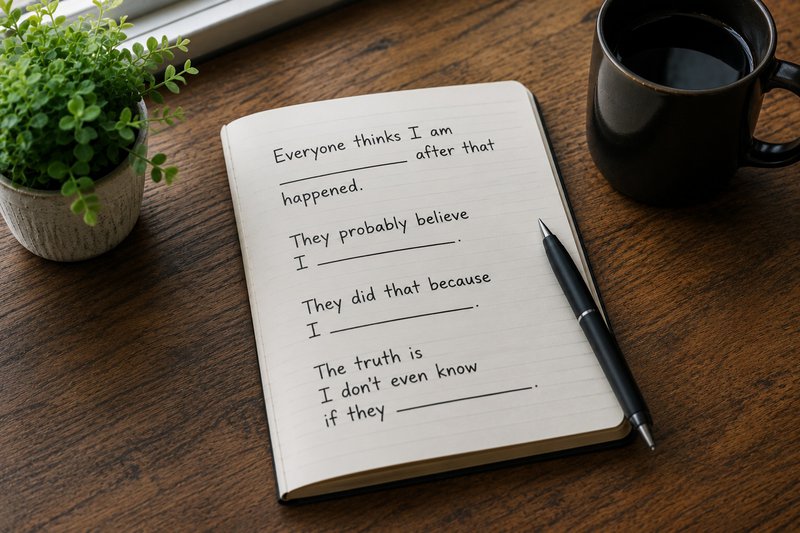
Human beings do not like uncertainty.
When information is missing, our minds naturally try to complete the picture. An unanswered phone call makes us wonder why a person called. Seeing someone who looks upset can leave us questioning whether we caused it somehow. If a person suddenly treats us differently than usual, we begin searching for an explanation.
The mind wants a complete story.
Unfortunately, the explanation we create is not always accurate.
We may decide:
- They are ignoring me.
- They do not care about me.
- They are trying to disrespect me.
- They think they are better than me.
- People are talking about me behind my back.
- Something must be wrong between us.
- I am going to get fired.
- This relationship is falling apart.
- Nobody appreciates what I do.
Once the story begins, our emotions often follow.
Anger can develop over something that may never have happened. A sense of rejection may appear even though nobody actually rejected us. Before long, anxiety takes hold over a future that has not occurred, or resentment develops toward someone who may have no idea anything is wrong.
The story becomes emotionally real even when the facts behind it remain uncertain.
During Addiction We Learned to Escape Uncomfortable Feelings

During active addiction, uncomfortable emotions often created an immediate urge to change how we felt.
Anger might lead to drinking, while loneliness could lead to using. Anxiety might create a desire to escape. Embarrassment, shame, boredom, fear, resentment, or disappointment could all become reasons to reach for something that provided relief.
Recovery asks us to develop a very different relationship with our emotions.
Rather than immediately escaping a feeling, we learn to experience it. Instead of assuming every uncomfortable emotion means something must be wrong, we begin recognizing that feelings are temporary. Over time, automatic reactions can give way to something much healthier: a pause.
That pause creates space.
Within that space, we can begin asking whether our emotional reaction is based on what actually happened or on what we believe happened.
There is a significant difference between the two.
Feelings Are Real, but They Are Not Always Evidence

One of the most important lessons in emotional regulation is that a feeling can be completely real without the interpretation behind it being accurate.
Feeling rejected does not automatically mean someone dislikes you.
A sense of disrespect does not necessarily mean another person intended to upset you or make you look bad in front of others.
Fear can be genuine without proving that the thing you fear is going to happen.
Likewise, anger does not establish that someone deliberately harmed you.
Our feelings deserve attention and compassion. They deserve to be understood. What they do not deserve is automatic promotion to the status of fact.
This can be difficult because strong emotions often create a sense of certainty.
When anger takes over, the mind begins building a case. Previous problems suddenly come to mind, while every piece of information supporting our conclusion becomes easier to notice. Soon we are replaying conversations, assigning motives, and predicting what the other person will say next.
Before long, we may feel completely certain that we understand the situation.
Perhaps we do.
But perhaps we do not.
Emotional sobriety gives us enough humility to leave room for both possibilities.
Mind Reading Can Create Resentments That Never Needed to Exist

One common thinking habit is what psychologists sometimes call mind reading.
Mind reading occurs when we assume we know what another person is thinking or why they behaved a certain way.
Imagine someone walking past you without saying hello.
The fact is simple:
They walked past without saying hello.
Our interpretation can be considerably more complicated.
Maybe we decide they deliberately ignored us because they are upset. Another possibility our mind might invent is that they think they are better than us. An old insecurity may even jump in with, "I knew they never really liked me."
Yet dozens of other explanations are possible.
Perhaps they did not see us. They could have been distracted, worried about something completely unrelated, running late, exhausted, or dealing with bad news.
None of those explanations is necessarily correct either.
The important point is that we do not know yet.
Our minds often choose one explanation and then emotionally respond as though the mystery has already been solved. When we automatically select the most negative interpretation, significant emotional distress can grow out of very little information.
Catastrophizing Can Turn Uncertainty Into Disaster
Another common thinking pattern is catastrophizing.
Something relatively small happens, and the mind races toward the worst possible outcome.
Suppose your boss asks to speak with you.
An immediate thought might be, "I must have done something wrong."
That concern becomes, "Maybe I'm getting written up."
A few moments later, the thought grows into, "What if I'm going to lose my job?"
Soon the mind arrives at, "How am I going to pay the bills?"
In less than five minutes, we can emotionally experience losing a job that we still have.
Recovery does not require unrealistic optimism. Difficult things really do happen. People lose jobs, relationships end, financial problems occur, and disappointment is part of life.
Emotional regulation, however, allows us to stop suffering through every possible disaster before it happens.
Reality can be dealt with when it arrives.
We do not have to live through imaginary emergencies in advance.
Expectations Can Quietly Become Resentments
Sometimes the story we tell ourselves begins with an expectation.
We believe someone should call or understand what we need. Perhaps we think they should offer help, show appreciation, apologize, or respond exactly as we would.
When reality does not match that expectation, disappointment can quickly become resentment.
There is one significant problem: the other person may never have agreed to our expectation.
They may not even know it exists.
It is surprisingly easy to become angry with people for failing to follow rules that existed only in our own minds.
This does not mean expectations are always unreasonable. Healthy relationships depend on trust, communication, boundaries, and accountability.
Emotional sobriety asks us to distinguish between a clear agreement and an unspoken expectation.
One can be discussed openly.
The other can quietly become a story.
The Difference Between Facts and Interpretations
A useful emotional-regulation exercise is learning to separate what happened from what we believe it means.
Imagine sending someone a message in the morning and receiving no response by evening.
The fact is:
I sent a message and have not received a response.
One interpretation might be:
They are ignoring me.
Another could be:
They must be angry with me.
Our minds might go even further:
They do not value our relationship.
Any of those interpretations could eventually prove correct. At the moment, however, they remain interpretations rather than facts.
That distinction matters.
Confusing interpretation with fact often causes us to react before enough information is available. An angry follow-up message might be sent. We could withdraw from the person or complain about them to somebody else. In our heads, an argument may already be underway.
Then the person finally responds and explains that they spent the day dealing with a family emergency.
By that point, we may have created an emotional mess that never needed to happen.
Ask Yourself What You Actually Know
When emotions begin escalating, slowing the situation down can help.
Start with a basic question:
What happened?
Describe only what an outside observer could verify.
Next consider:
What am I telling myself about what happened?
This is usually where assumptions begin revealing themselves.
Then examine the evidence:
What do I actually know?
Focus on what exists right now rather than what you fear, suspect, or remember from another situation years ago.
Finally, consider:
Is there another possible explanation?
You do not have to believe the alternative explanation. Simply recognizing that more than one possibility exists can reduce the emotional intensity.
Pause Before You Send the Text
Technology gives us the ability to react immediately.
That is not always an advantage.
Angry texts, emails, comments, and social media posts can be sent in seconds. The emotional impulse happens quickly, but the consequences can last considerably longer.
If you are emotionally activated, waiting before responding can be one of the simplest forms of emotional regulation.
Write the message if you need to, but leave it unsent.
Walk away for a while. Talk with someone you trust. Prayer or meditation may help you settle your thinking. A short walk, a meeting, or a few minutes spent reconnecting with recovery can also provide enough distance to see the situation differently.
Return to the issue after the emotional intensity decreases.
You may still decide that something needs to be addressed.
The difference is that you will be responding instead of reacting.
Check the Story With Someone You Trust
Recovery gives us something extremely valuable: other people.
Sponsors, recovery friends, counselors, therapists, clergy, trusted family members, and supportive peers can sometimes see situations more clearly because they are not experiencing the same emotional intensity.
We might tell someone, "They said this to me, and I think they were trying to embarrass me."
A trusted person may see another possibility and ask, "Could they have meant something else?"
That question can be frustrating when we are already convinced that our interpretation is correct.
It can also be exactly what we need.
Supportive people do not always have to agree with our story to support us.
Sometimes genuine support means helping us examine it.
Emotional Sobriety Requires Curiosity
Curiosity is one of the best alternatives to assumption.
Rather than deciding what someone meant, we can ask.
A thought such as "They obviously don't care" might become a simple question: "Everything okay? I noticed you seemed distant today."
When criticism is what we hear, clarification can help: "I want to make sure I understood what you meant."
If we are worried that someone is angry with us, we might simply ask, "Are we okay?"
These conversations are not always easy.
Occasionally, they confirm that there really is a problem. At other times, we discover that the situation had little or nothing to do with us.
Either way, we are dealing with reality instead of imagination.
That is much healthier ground.
Not Every Thought Deserves Our Attention
The mind produces thoughts constantly.
Some are useful, while others are ridiculous. Fear can generate one thought and anger another. Old experiences can shape what enters our minds, just as insecurity can influence what we believe about ourselves and other people.
Some thoughts are simply wrong.
Having a thought does not mean we have to obey it.
Suspicion does not always require an investigation. Imagined criticism does not automatically require a defense. Likewise, every emotional impulse does not deserve an immediate response.
A thought can appear without becoming a decision.
An emotion can rise without becoming an action.
That is emotional regulation.
Old Wounds Can Write New Stories
Sometimes our assumptions are shaped by earlier experiences.
A history of abandonment can make silence feel like rejection. Growing up around constant criticism may cause ordinary feedback to feel like an attack. After being repeatedly lied to, uncertainty can begin to feel dangerous. If conflict once led to chaos, even minor disagreement may trigger fear.
These reactions make sense because our minds learn from experience.
Problems develop when yesterday's experiences automatically determine today's interpretation.
A person in our present life can end up paying an emotional debt created by someone from our past.
Recovery gives us an opportunity to recognize when that is happening.
Consider asking yourself:
Is my reaction entirely about what is happening right now, or is something from my past influencing how I see this?
Recognizing the connection does not make the current feeling disappear. What awareness can do is give us more choices about what happens next.
Step Work Can Help Us Question the Stories
Twelve Step recovery repeatedly asks us to examine our thinking.
Inventory gives us an opportunity to look closely at resentments, fears, harms, motives, and recurring patterns. Sharing that inventory with another person can expose distortions that were difficult to recognize alone.
Making amends shifts attention toward our own actions rather than keeping us trapped in endless analysis of someone else's behavior.
Prayer and meditation can create additional space between thoughts and reactions.
Practicing recovery principles also encourages humility.
Humility does not require believing that we are always wrong.
It means accepting that we are capable of being wrong.
That realization can be enormously freeing.
We no longer have to defend every conclusion our minds produce.
Sometimes the Story Is True
Emotional regulation should never become an excuse for dismissing legitimate concerns.
Sometimes another person really is angry with us. Unfair treatment happens. Relationships can become unhealthy, and boundaries sometimes need to be established. People can lie, manipulate, betray, or harm us.
Emotional sobriety does not require pretending otherwise.
The goal is not to replace every negative assumption with a positive one.
The goal is to move toward reality.
Once the situation becomes clearer, we can decide what response is appropriate.
Communication may be necessary. In another situation, an apology could be called for. Setting a boundary may be the healthiest response, while some circumstances require accepting something we cannot change or removing ourselves from a harmful situation.
Whatever the answer, we are more likely to find it when responding to facts rather than reacting to a story.
Try a Simple Reality Check
The next time you notice yourself becoming angry, anxious, hurt, or resentful, try writing down four things:
1. What happened?
Describe the event without interpretation.
2. What story am I telling myself?
Identify what you believe the event means.
3. What do I actually know?
Separate evidence from assumption.
4. What is one healthy next action?
Perhaps you need to ask a question. Waiting may be the better choice. Calling your sponsor or another trusted person could help you see things more clearly. In some situations, a boundary needs to be established.
There will also be times when the healthiest decision is to do nothing tonight and reconsider the situation tomorrow.
The goal is not to eliminate emotion.
It is to create enough space to choose what happens next.
We Can Stop Fighting Battles That Only Exist in Our Heads
Recovery gives us plenty of real-life problems to deal with.
We do not need to manufacture additional ones.
An unanswered text does not automatically mean rejection. Someone else's bad mood may have nothing to do with us. Criticism is not always an attack, and an uncomfortable conversation does not necessarily represent a threat. Uncertainty does not guarantee disaster.
Sometimes we simply do not know yet.
Being able to tolerate that uncertainty is part of emotional sobriety.
Instead of writing the ending before all the facts arrive, we can wait.
Rather than assigning motives, we can ask questions.
When emotions are running high, we can pause before reacting.
Trusted people can help us check our thinking when we are too close to the situation to see it clearly.
Most importantly, recovery can teach us that the first story our minds produce is not necessarily the truth.
Sometimes serenity begins with being willing to say:
Maybe there is another way to see this.