

Medications such as Ozempic and Wegovy have become widely known for treating diabetes and helping people lose weight. Now researchers are looking at alcohol use disorder and asking a very different question:
Could the same type of medication also help people reduce alcohol cravings and heavy drinking?
On July 30, 2026, the U.S. Department of Veterans Affairs announced a large clinical trial that will test semaglutide as a possible treatment for moderate to severe alcohol use disorder. The study will include more than 600 Veterans at 18 VA medical centers across the country.
The announcement is encouraging, especially for people whose alcohol use has not responded fully to existing treatment. However, it is important to understand exactly what researchers know, what remains uncertain, and what this development does—and does not—mean for people in recovery today.s such as Ozempic and Wegovy are widely known for treating type 2 diabetes and supporting chronic weight management. Now, new research is exploring whether semaglutide and similar medications could also help people with alcohol use disorder reduce alcohol cravings, heavy drinking, and the pull of alcohol’s reward effects.
On July 30, 2026, the U.S. Department of Veterans Affairs announced the CRAVE trial, a large clinical study of semaglutide for Veterans with moderate to severe alcohol use disorder. The study will enroll more than 600 Veterans at 18 VA medical centers and examine whether weekly semaglutide injections can safely reduce alcohol consumption and improve quality of life.
For people seeking help with drinking, this news may offer hope, especially when existing alcohol use disorder treatment has not fully reduced cravings or heavy drinking. But semaglutide is not currently FDA-approved to treat alcohol use disorder, and this VA study is designed to answer important questions about its safety, effectiveness, and role alongside counseling, peer support, and established recovery medications.
Here is what the new VA study, early semaglutide research, and the growing interest in GLP-1 medications for alcohol cravings could mean for recovery today.Medications such as Ozempic and Wegovy have become widely known for treating diabetes and helping people lose weight. Now researchers are examining a very different question:
Could the same type of medication also help people reduce alcohol cravings and heavy drinking?
On July 30, 2026, the U.S. Department of Veterans Affairs announced a large clinical trial that will test semaglutide as a possible treatment for moderate to severe alcohol use disorder. The study will include more than 600 Veterans at 18 VA medical centers across the country.
The announcement is encouraging, especially for people whose alcohol use has not responded fully to existing treatment. However, it is important to understand exactly what researchers know, what remains uncertain, and what this development does—and does not—mean for people in recovery today.

What Are GLP-1 Medications?
GLP-1 receptor agonists are a class of medications originally developed to help manage type 2 diabetes. Some have also been approved for chronic weight management.
Semaglutide is currently approved for specific uses related to type 2 diabetes and chronic weight management, depending on the product and the person’s medical situation. It is not currently approved by the FDA as a treatment for alcohol use disorder. Readers who want to review the medication’s approved uses and safety information can consult the FDA semaglutide prescribing information.
Semaglutide is the active medication in products including Ozempic and Wegovy. These medications imitate the effects of a naturally occurring hormone called glucagon-like peptide-1, commonly shortened to GLP-1.
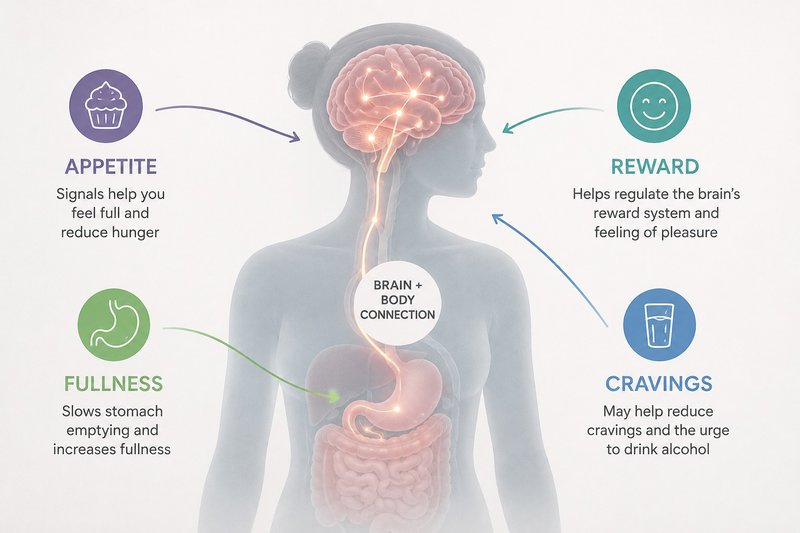
GLP-1 helps regulate blood sugar, slows digestion, and influences feelings of hunger and fullness. Researchers have also become interested in the way GLP-1 medications may affect areas of the brain involved in motivation, reinforcement, and reward.
That connection to the brain’s reward system has raised an intriguing possibility. If GLP-1 medications can reduce the reinforcing pull of food, could they also reduce the reinforcing effects of alcohol?
Scientists do not yet have a complete answer. However, reports from patients, animal studies, medical-record analyses, and early human trials have all pointed in the same general direction: some people taking GLP-1 medications appear to experience less interest in alcohol, fewer cravings, or reduced alcohol consumption.
One reason researchers remain interested is that observational GLP-1 research has found associations between GLP-1 medication use and lower rates of alcohol-related hospitalization. Studies like this cannot prove that the medication caused the change, but they can help identify questions worth testing in larger randomized trials.
What Is the New VA Study?
The VA study is officially known as the Cessation or Reduction of Alcohol Consumption in Veterans trial, or CRAVE.
It is a randomized, double-blind, placebo-controlled Phase 3 trial. That means participants will be randomly assigned to receive either semaglutide or an inactive placebo, and neither the participants nor the researchers directly working with them will initially know who received which treatment.
This type of study is designed to provide much stronger evidence than personal reports or observational research.
The trial plans to enroll more than 600 Veterans between the ages of 18 and 80 who have moderate or severe alcohol use disorder. Participants will receive weekly injections of semaglutide or placebo, and researchers will measure changes in alcohol consumption, overall health, safety, and quality of life. The trial is recruiting through 18 VA Medical Centers.
People interested in learning more can review the CRAVE trial record on ClinicalTrials.gov, including the study’s eligibility criteria, participating locations, planned outcomes, and current recruitment status. The record describes CRAVE as a Phase 3, randomized, double-blind, placebo-controlled trial of semaglutide for Veterans with moderate to severe alcohol use disorder.
Why Is the VA Studying This Medication?
The VA reports that more than 400,000 Veterans nationwide have been diagnosed with alcohol use disorder. Veterans may also experience overlapping challenges such as chronic pain, trauma, depression, anxiety, sleep disruption, and physical health conditions that can complicate recovery.
Existing alcohol use disorder treatments help many people, but no treatment works equally well for everyone.
There are currently three medications approved by the U.S. Food and Drug Administration specifically for alcohol use disorder:
- Naltrexone, which may reduce the urge to drink and the rewarding effects of alcohol
- Acamprosate, which may help people maintain abstinence
- Disulfiram, which causes an unpleasant physical reaction when alcohol is consumed
These are not “substitute addictions.” The National Institute on Alcohol Abuse and Alcoholism explains that the three approved AUD medications, naltrexone, acamprosate, and disulfiram, can be used alongside counseling, mutual-support groups, and other recovery supports when medically appropriate.
Despite their availability, medications for alcohol use disorder remain underused. Some people do not know medication is an option. Others cannot take a particular medication because of a medical condition, side effects, limited access, or a poor response.
The need is not necessarily for one medication that works for everyone. The greater need is for a wider range of choices that can be matched to each person’s health, recovery goals, and individual response.
Semaglutide could eventually become one of those choices, but the evidence must first show that its benefits outweigh its risks.
What Have Earlier Studies Found?
The VA trial did not appear out of nowhere. It follows several years of increasingly encouraging research.
A Small 2025 Clinical Trial
A randomized clinical trial published in JAMA Psychiatry in 2025 included 48 adults with alcohol use disorder. Half received low-dose semaglutide, and half received a placebo.
Over nine weeks, semaglutide reduced alcohol craving, drinks consumed per drinking day, and some measures of heavy drinking. It also reduced the amount of alcohol participants consumed during a controlled laboratory drinking procedure.
However, it did not significantly change every outcome. Researchers did not find a significant difference in the overall number of drinking days or average drinks per calendar day. The study’s authors described the results as initial evidence that justified conducting larger trials—not as proof that semaglutide was ready for routine alcohol treatment.
That distinction matters. Small early trials help researchers identify promising signals, but they can sometimes produce results that do not hold up in larger studies.
Readers who want to look more closely at the study can review the full 2025 semaglutide clinical trial. Its findings support cautious optimism, not a conclusion that semaglutide is already ready to replace established alcohol use disorder treatments.
A Larger 2026 Trial
A larger trial published in The Lancet in 2026 studied 108 treatment-seeking adults who had both alcohol use disorder and obesity.
Participants received semaglutide or placebo for 26 weeks. Both groups also received standard cognitive behavioral therapy.
Heavy drinking days declined in both groups, but the reduction was greater among participants receiving semaglutide. The semaglutide group experienced a 41.1-percentage-point reduction from baseline, compared with a 26.4-point reduction in the placebo group. Gastrointestinal side effects occurred more often with semaglutide but were generally described as temporary and mild to moderate.
This study strengthened the case for further research. It also demonstrated something important about how medication might be used in practice: semaglutide was added to behavioral treatment rather than presented as a replacement for it.
The study still had limitations. It took place at a single center, and all participants had obesity in addition to alcohol use disorder. Researchers still need to learn whether similar results will occur in people across a wider range of body weights, medical histories, drinking patterns, and recovery goals.
The full 2026 semaglutide trial is especially useful because it reports both the potential benefit and the limits of the evidence: participants had alcohol use disorder and obesity, treatment took place at one center, and semaglutide was provided alongside cognitive behavioral therapy.
How Might GLP-1 Medications Affect Alcohol Cravings?
Alcohol use disorder is not caused by one brain chemical, one behavior, or one personal weakness. It develops through a complicated interaction of genetics, environment, learning, stress, physical health, emotional health, and changes in the brain.
Repeated alcohol use can strengthen learned associations between alcohol and relief, pleasure, social connection, escape, or emotional numbness. Over time, sights, places, feelings, and situations connected with drinking may trigger intense urges.
GLP-1 receptors are found not only in the digestive system but also in areas of the brain involved in appetite, reinforcement, and motivation. Researchers believe that stimulating these receptors may reduce the rewarding or attention-grabbing quality of alcohol.
In everyday language, alcohol may feel less compelling to some people taking the medication. A person may still know that alcohol is available, but the thought of drinking may not carry the same intensity or urgency.
That explanation remains a developing scientific theory. Researchers are still investigating whether the medication primarily changes craving, reward, impulsivity, appetite, stress responses, or a combination of several processes.
They are also trying to determine why some people may respond more strongly than others.
Could Semaglutide Become a Treatment for Alcohol Use Disorder?
Possibly—but it is too early to say that it will.
Semaglutide is not currently FDA-approved specifically for alcohol use disorder. Prescribing it for that purpose would be considered off-label use.
The VA’s decision to conduct a Phase 3 trial shows that the treatment is being taken seriously. Phase 3 studies are generally designed to determine whether a treatment is effective and safe enough for broader clinical use.
Even so, researchers still need answers to several important questions:
- How much does semaglutide reduce heavy drinking compared with placebo?
- Does it help people achieve abstinence, reduce drinking, or both?
- Which patients are most likely to benefit?
- Does it work for people who do not have obesity or diabetes?
- How long must someone remain on the medication?
- Do alcohol cravings return after the medication is stopped?
- How should it be combined with counseling, peer support, or other medications?
- Are the risks acceptable for people with alcohol-related liver, pancreatic, digestive, or nutritional problems?
- Is the treatment affordable and realistically accessible?
The CRAVE trial may answer some of these questions, although no single study will answer all of them.
Medication Does Not Replace Recovery
The possibility of a medication that reduces alcohol craving may create mixed reactions in recovery communities.
Some people may feel hopeful. Others may worry that medication is being presented as a shortcut, an easy solution, or a substitute for the work of recovery.
Those concerns deserve a thoughtful response.
A medication may reduce craving, but recovery usually involves more than the absence of craving. Many people also need practical ways to manage stress, emotional discomfort, negative thought patterns, and situations that can increase the risk of returning to alcohol. For readers who want to develop those skills, emotional regulation skill scan complement medication, counseling, treatment, and peer support. It may also require learning how to handle stress, repair relationships, manage emotions, establish boundaries, rebuild trust, find purpose, and respond differently to discomfort.
Medication does not automatically teach someone how to communicate honestly, recognize a resentment, make amends, cope with grief, or build a sober support system.
At the same time, needing medication does not make a person’s recovery less legitimate.
Medication and recovery support do not have to be opposing choices. According to NIAAA, medications for alcohol use disorder can be combined with behavioral treatment and mutual-support groups, helping some people create enough stability to do the deeper day-to-day work of recovery. Learn more about medication and recovery support.
Someone who uses naltrexone, acamprosate, antidepressant medication, medication for opioid use disorder, or another medically appropriate treatment is not necessarily avoiding recovery work. Medication may make it possible for that person to participate more fully in recovery.
For people who practice the Twelve Steps, structured Twelve Step work can be one way to continue that recovery process while receiving appropriate medical support. A workbook can provide prompts for reflection and action, but it should be used alongside the person’s chosen support system rather than as a replacement for professional care, treatment, or mutual-support groups.
The most helpful question may not be, “Is medication real recovery?”
A better question is, “Does this treatment safely help the person stop drinking, reduce harm, regain stability, and build a healthier life?”
GLP-1 Medications Are Not Risk-Free
The widespread popularity of GLP-1 drugs can make them seem routine, but they are powerful prescription medications.
Common side effects can include nausea, vomiting, diarrhea, constipation, abdominal discomfort, and reduced appetite. FDA prescribing information also includes important warnings and contraindications, including restrictions for people with certain personal or family histories of medullary thyroid carcinoma or multiple endocrine neoplasia syndrome type 2. Product labeling also addresses risks involving conditions such as pancreatitis, gallbladder disease, dehydration-related kidney injury, and severe gastrointestinal reactions.
These concerns may be especially relevant in people whose prolonged alcohol use has already affected the pancreas, liver, digestive system, nutrition, or hydration.
No one should obtain semaglutide informally, use another person’s medication, or attempt to treat alcohol cravings without medical supervision.
The VA specifically warns Veterans not to self-medicate or replace established alcohol use disorder treatment with unprescribed GLP-1 medication.
What Does This Mean for Someone Seeking Help Today?
The most important point is that people do not need to wait for the VA study to receive effective help.
Evidence-based treatments for alcohol use disorder are already available. People who want practical help with cravings, relapse triggers, sleep disruption, and the challenges of early sobriety can also explore these craving and relapse tools. Resources like these do not replace medical care or treatment, but they can give people concrete exercises and routines to use between appointments, meetings, and other forms of support. Depending on the individual, treatment may include medically supervised withdrawal management, counseling, residential or outpatient treatment, FDA-approved medication, family support, and mutual-support programs.
People who have been drinking heavily should not abruptly stop without considering the risk of withdrawal. Alcohol withdrawal can become medically dangerous and may involve seizures and other serious complications. A healthcare professional can help determine whether medical supervision is needed.
Someone already taking a GLP-1 medication who notices a change in alcohol cravings should discuss it with the prescribing clinician. That observation may be meaningful, but it does not establish that the medication is safe or appropriate as a stand-alone alcohol treatment.
People interested in the VA trial can review the CRAVE study listing or contact one of the participating VA medical centers to ask about eligibility. Enrollment began in July 2026, and the VA lists the study as recruiting.
For people who are ready to explore professional care, the NIAAA Alcohol Treatment Navigator explains how to look for quality treatment, including programs that offer counseling and medication when appropriate. Find evidence-based alcohol treatment.
A Reason for Hope—With Appropriate Caution
The history of addiction treatment includes many ideas that initially appeared promising but failed to deliver meaningful results. It also includes treatments that were once misunderstood or resisted but later saved lives.
GLP-1 medications may eventually become an important addition to alcohol use disorder treatment. Early studies suggest that semaglutide may reduce cravings, lower alcohol consumption, and decrease heavy drinking for some people.
The VA’s large Phase 3 trial represents an important next step. It could help determine whether those early results translate into a practical treatment for Veterans and, eventually, for the wider population.
For now, semaglutide should be viewed as a promising subject of research—not a proven cure for alcohol use disorder.
Recovery rarely comes from one tool alone. Medication, counseling, peer support, personal responsibility, medical care, spiritual growth, and healthy daily practices do not have to compete with one another. For many people, lasting recovery grows from using the right combination of supports at the right time.
The real promise of this research is not that one weekly injection will replace recovery.
This article is for educational purposes only and does not provide medical advice. Do not begin, stop, share, or change any prescription medication without consulting a qualified healthcare professional.